

A Micromosaic Valentine
An Introduction to the Art Form That's Inspired the Newest Carta Paper Designs


Micromosaics have been on my mind lately! As you may know, I'm a keen collector of antique intaglios, those charming and portable plaster cameos collected by Grand Tourists in the 18th and 19th centuries. To my mind, micomosaics are a sort of cousin to intaglios: intimately scaled, beautifully crafted, intricate in design and color-- quite fabulous. My newest patterned papers are studded with beautiful examples of this art form, and I thought you might enjoy a bit of background on these treasures in miniature.
I've long been fascinated by art forms that involve meticulous craft technique, accrual & tessellation. Micromosaics tick all of those boxes for me, with their meticulously arranged bits of colored glass and varied subject matter. It was a surprise to learn that in the 18th century, these miniature variations of mosaic art were sometimes poorly received, as described by researcher Heike Zech in her book, Micromosaics (V&A, 2018). She quotes Goethe, who wrote in 1786-8: "Our times are worse than we think... The art of mosaics which once gave the Ancients their paved floors and the Christians the vaulted heavens of their churches, has now been degraded to snuffboxes and bracelets." Zech continues: 'For him, the reduction in size was clearly a fall from grace. With his remark, Goethe dismisses micromosaics as a trivialization of the great heritage of mosaics. Ancient mosaics shared the gravitas of the buildings they adorned, and were contextualized by the architecture around them... And yet, precisely as a result of their portability, micromosaics arguably became a more independent art form than many of their classical predecessors."

Clearly, I lack Goethe's erudition (!) as, for me, the intimate scale is one of the most fascinating and attractive aspects of these works. Early examples date from the ancient Roman and Byzantine eras, and among the most famous of these is the Doves of Pliny, a micromosaic discovered in Emperor Hadrian's villa in Tivoli, shown above. The excavation of this piece greatly inspired eighteenth century mosaicists, and Grand Tourists in the mid 19th century found the resulting works to be wonderful and easily portable souvenirs. Production flourished in Italy during that period and beyond.
A superb plinth from The Victoria & Albert Museum: Micromosaic, malachite, lapis lazuli, marble and pierced gilt bronze, Rome, ca.1800, Giacomo Rafaelli.
Both the Victoria and Albert Museum in London and the Los Angeles County Museum of Art have noted collections of micromosaics, mainly from the collections of Sir Arthur Gilbert (1913-2001), who actually coined the term, micromosaic. But the wonderful thing about objects like this is that along with the masterpieces housed in the world's great museums, there are also many charming and affordable examples to be found in auction houses and antiques shops, which can be collected by everyday people. These are generally less fine, of course, but they still offer an opportunity for people who, like me, love creating mini museums on our desks or side tables.
A snuffbox, ca. 1825, by Tomasso Calandrelli, Rome, from the V & A Museum
Here's a wonderful video about the making of micromosaics, courtesy of the V&A:
I've been collecting images of micromosaics for several years, and it's been great fun to compose them and to create these new patterned papers. The first background color had to be a vivid red: as the new papers were due to arrive in early February, I began thinking of this new work as a Valentine to all of you.

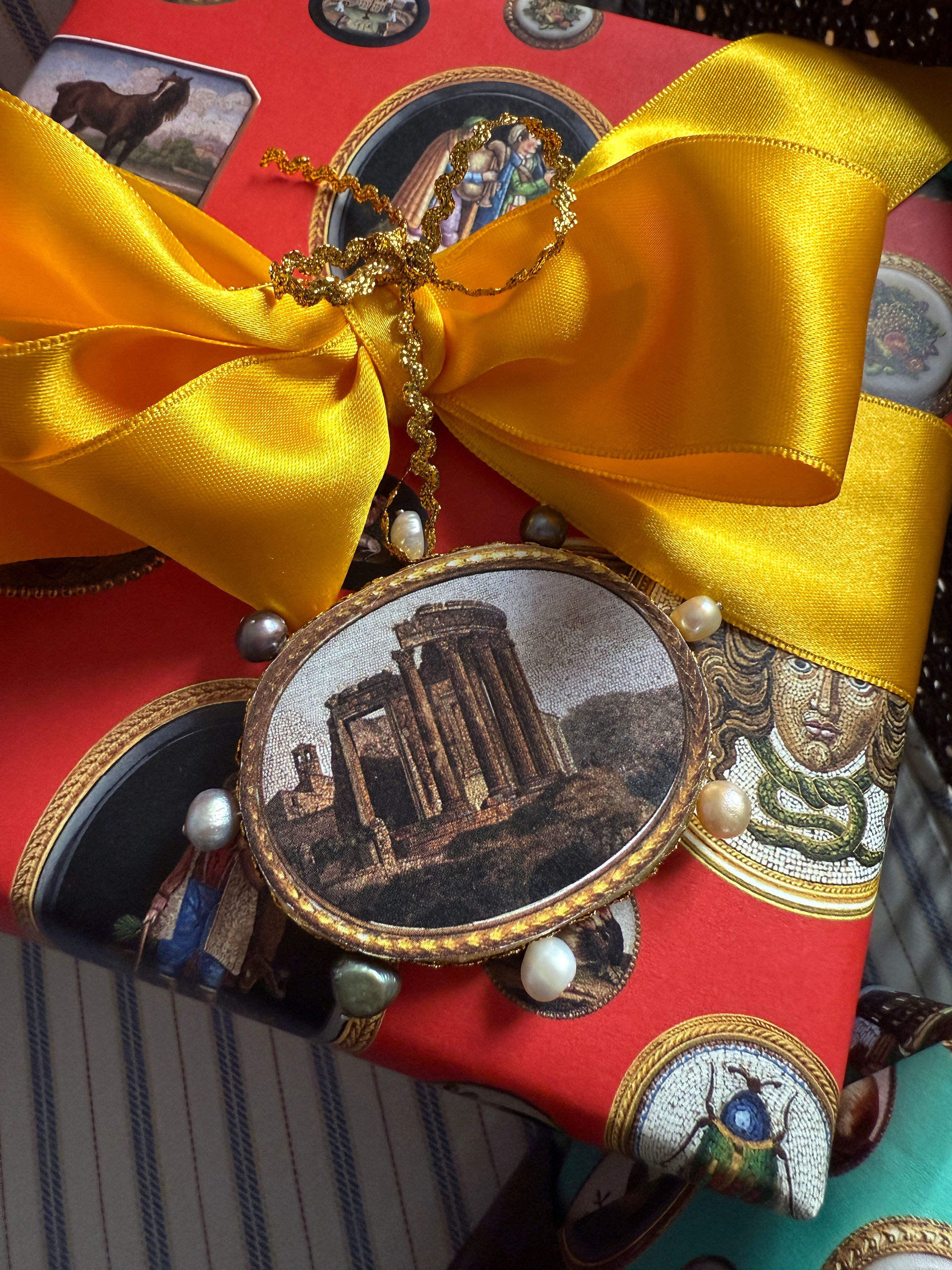
On the left, sheets of red micromosaic gift wrap, and on the right, a little Valentine gift with a topper very simply made from an image cut out of the wrapping paper, a bit of foam board and some gold rick rack. A few pearls stuck on the border with pins finish it off. Cute, no?
The second colorway is a duck egg blue, which, to my eye, sets off the micromosaics beautifully.


On the left, a few sheets of the duck egg blue micromosaic gift wrap, and on the right, one more gift with a topper featuring one of my favorites of all the wrapping paper micromosaics: the very serious rabbit.
A pair of square valet trays: these are 6 inches square, to give you an idea of the scale of the paper's images.
And, of course, I had to add stickers!


Each set of stickers includes five different stickers, all about 3 inches tall. They feature a protective matte coating, so they're perfect for laptops, folders, boxes, and of course, luggage.
Notebooks in both red and duck egg blue are also in the works, but they'll be just a few weeks more. I hope you've enjoyed this introduction to the art of micromosaics, and if you're curious to continue your exploration, I've included a few reading suggestions below. Happy Valentine's Day!

Suggested reading:
Micromosaics, an article from the Antique Jewelry University (Lang Antiques):
Small but Mighty: the Fascinating History of Micromosaics, by Emily Otranto (Rau Antiques)
Mocromosaics: Masterpieces from the Rosalinde and Arthur Gilbert Collection, by Heike Zech,
Published by V & A Publishing, 2018

Micromosaics: The Gilbert Collection, by Jeanette Hanisee Gabriel,
Published by Philip Wilson Publishers, 2000

Micromosaics Private Collections, by Jeanette Hanisee Gabriel,
Published by Movement Publishing, 2016

Souvenir is the blog for Parvum Opus, an artist-run studio specializing in artistic decorative objects and home furnishings. Comment below to join the conversation, and if you enjoyed this, don't forget to subscribe to receive an email when we publish new posts.
